
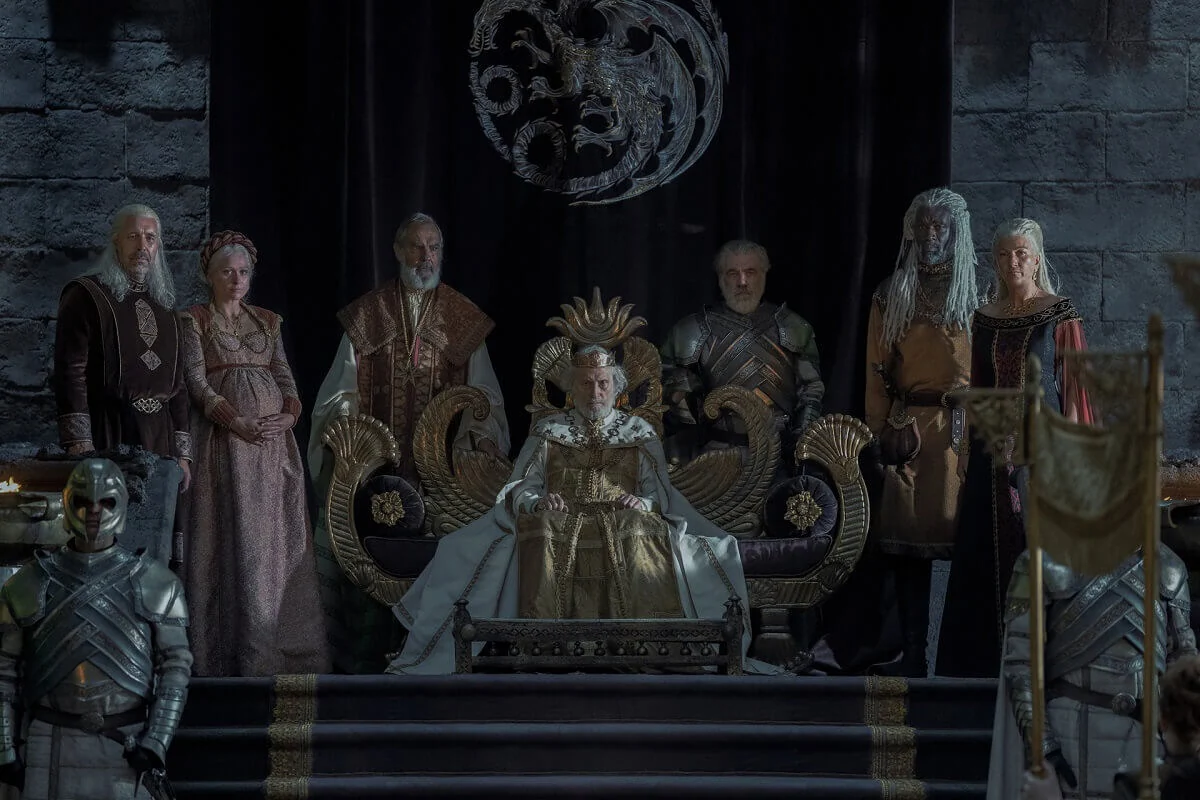
Key takeaways
- The council chooses Viserys; it does not prove Rhaenys incapable.
- The same peaceful transfer can be remembered as both stability and exclusion.
- Experience gives Rhaenys a perspective, not supernatural certainty.
Episode facts are distinguished from our interpretations. This article follows television continuity and does not use future book outcomes to fill gaps.
Start with the distinction the prologue makes
Rhaenys is a serious candidate in the succession considered by the Great Council, but the lords choose Viserys. The opening establishes an exclusion based on the realm's preference, not an examination demonstrating that she lacks intelligence or political ability. Those are different claims, and a character study should not silently substitute one for the other.
Our reading begins with that distinction: an institution can deny someone an office and still need to reckon with the person afterward. A rejected claimant remains part of a family network with memory, resources, and reasons to judge how the resulting settlement works.
Why her perspective differs from Viserys's
The successful candidate can remember the council as a mechanism that prevented conflict. The unsuccessful candidate can remember the same event as the point at which the terms were weighted against her. Neither requires a different sequence of events. They differ in which cost becomes the central meaning of the event.
This is a useful way to read Rhaenys without importing later scenes: she has reason to distinguish what a ruler promises from what a political class is willing to accept. Her position gives her access to the gap between a principle praised in public and a principle that survives a consequential choice.
Do not turn experience into omniscience
Being excluded does not automatically make a character right about every decision or free of personal ambition. It gives her experience, not an infallible view of the future. Similarly, recognizing a biased institution does not tell us which response to it will be safest or most effective.
A more productive question than whether Rhaenys should be admired unconditionally is what evidence her experience lets her see that others may discount. Our interpretation is that the prologue equips her to notice fragility in apparently peaceful arrangements. It does not tell viewers what she will do with that awareness.
How to read her place in the family tree
Keep kinship, selection, and support separate. Being a close royal relative supplies a claim; the council supplies a decision; powerful relationships influence what happens around that decision. Collapsing these into a single inheritance arrow makes the council look like a mechanical calculation rather than a political choice.
On a premiere rewatch, ask who benefits from describing the outcome as inevitable. That word closes discussion of the alternatives. A character who embodies an alternative can remain consequential even when the official ceremony has moved on. Rhaenys's importance at this boundary is precisely that the opening's rejected possibility has a face.
Sources & reading notes
Checked September 5, 2026. Linked references support the episode facts or credited production comments; the analysis and discussion prompts are original. External pages, images, recommendations, and comments may reveal later episodes or book events.
Show external sources · spoiler caution
- Cover image source ↗Ollie Upton / HBO. Image copyright remains with its owner.
- Episode record · Wikipedia ↗Used to check episode events and credits; linked pages may include later-story material.
Filed safely through Season 1, Episode 1.